Microsoft Excel add-in

IBAN validation and bank lookup in Excel

Select a column of IBANs and IBANAPI checks every one of them, then adds the bank name, BIC and country next to it. Built for finance teams checking supplier, payroll and customer bank details.

10,000 IBANs per run
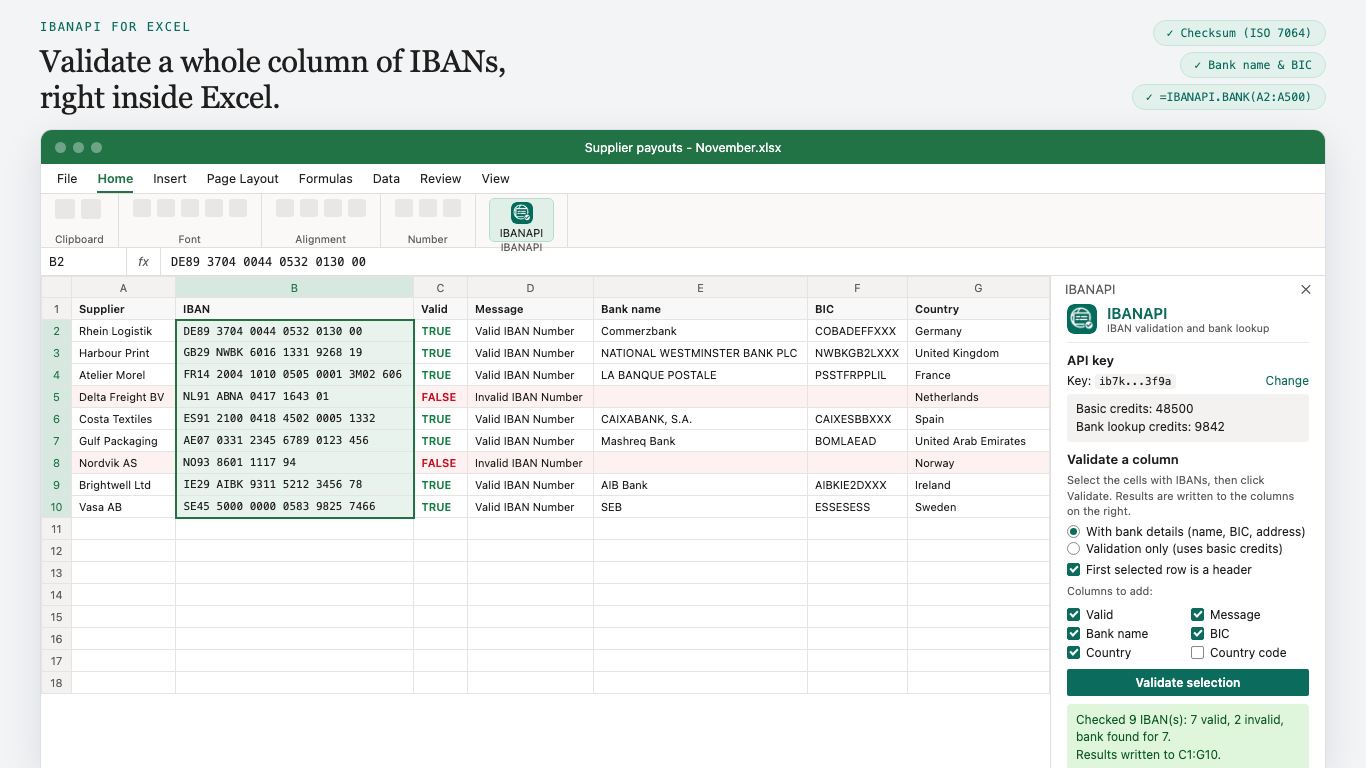
An Excel workbook of supplier IBANs validated by the IBANAPI add-in, with Valid, Message, Bank name, BIC and Country columns filled in and the IBANAPI task pane open on the right
Formulas

Four functions, one cell or a whole range

=IBANAPI.VALID(B2:B500) // TRUE or FALSE, uses basic credits only =IBANAPI.BANK(B2:B500) // bank name =IBANAPI.BIC(B2:B500) // BIC / SWIFT code =IBANAPI.LOOKUP(B2:B500, "city") // one field: valid, message, bank_name, bic, // country_name, country_code, currency_code, // sepa_member, address, city, zip, bank_account

Spaces, dashes and lowercase letters are cleaned up for you, and empty cells stay empty.

What it does

Two ways to check IBANs in Excel

Validate a column in one click from the IBANAPI pane, or use formulas that update as your data changes. Both use the same IBANAPI engine as our API.

Task pane

Validate a whole column

Select the IBANs, click IBANAPI on the Home tab, then Validate. Results go into the columns on the right: valid or not, the reason, bank name, BIC, country, currency, SEPA membership and bank address. You choose the columns, and the add-in asks before overwriting any cell.

Formulas

Use it like any other function

=IBANAPI.VALID, =IBANAPI.BANK, =IBANAPI.BIC and =IBANAPI.LOOKUP work on one cell or a whole range. Many cells recalculating at once are combined into a few bulk requests.

Your account

Your key, your credits

The add-in uses your own IBANAPI API key, stored on your device and never in the workbook. Pick validation only to use basic credits, or include bank details when you need them.

Install

Up and running in a couple of minutes

You need Excel for Microsoft 365 (Windows or Mac) or Excel on the web, and an IBANAPI API key. If you don't have a key yet, sign up for free and copy it from your dashboard.

01

Install the add-in

In Excel, go to Home > Add-ins, search for IBANAPI and click Add. In some versions the button is under Insert > Get Add-ins.

02

Add your API key

Click the IBANAPI button on the Home tab, paste your API key and click Save. The add-in checks the key and shows your remaining credits.

03

Validate your IBANs

Select the cells with IBANs, tick the columns you want and click Validate selection. Or type a formula such as =IBANAPI.BANK(B2:B100) in any cell.

Rolling it out to a team? A Microsoft 365 admin can deploy the add-in to everyone from the Microsoft 365 admin center, under Settings > Integrated apps.

Using Google Sheets instead? Try the IBANAPI Google Sheets add-on.

FAQ

Common questions about the Excel add-in

Is the add-in free?

The add-in itself is free to install. Each IBAN it checks uses credits from your IBANAPI account, exactly like an API call, so you can start with a free API key and move to a paid plan when you need more.

Which versions of Excel are supported?

Excel for Microsoft 365 on Windows and Mac, and Excel on the web. The add-in needs the Office shared runtime, which older one-time-purchase versions such as Excel 2016 and 2019 don't have.

How many credits does a check use?

With bank details, each IBAN uses 1 basic credit, plus 1 bank lookup credit when the bank is found. Validation only uses 1 basic credit. Each distinct IBAN is checked once, and results are kept for 6 hours while Excel is open, so recalculating doesn't use your credits again.

What data does the add-in access?

Only the cells you select, or the cells you pass to an IBANAPI formula. Those IBANs are sent to our API to be validated and the results are written back to your workbook. The details are in the Excel section of our privacy policy.

If I share the workbook, do others get my API key?

No. The key is stored by the add-in on your own device, never inside the workbook. Someone who opens your file adds their own key, and their checks use their own credits.

How many IBANs can I validate at once?

Up to 10,000 IBANs per run when you validate a selection. Formulas accept whole ranges too, for example =IBANAPI.BANK(A2:A500), and calls from many cells recalculating together are combined into bulk requests.

Does a valid IBAN mean the account exists?

No. A valid result means the IBAN is well-formed: right length, correct check digits, correct structure and, for many countries, a valid national account checksum. Only the bank can confirm the account is open and who holds it.